As organisations gear up for the year ahead, one thing is clear: performance and wellbeing can no longer be separate conversations.
At The Healing Centre of Australia, we’re seeing a shift. More leaders are asking: “How do we stop talking about wellness and actually embed it?” And that’s exactly what this audit is designed to support.
Right now, many leaders are feeling it: fatigue, disconnection, and pressure to do more with less. We are seeing it in the conversations we are having.
As of 1 December, new psychological health compliance codes are now enforceable in Victoria – a move that rightly places greater responsibility on employers to address psychosocial hazards in the workplace.
At a recent round table with HR leaders, one theme kept surfacing: we all know “trauma-informed workplaces” are important, but many fear they could get it wrong.
Managers worry about overstepping; HR wonders how to support leaders without expecting them to act like therapists.
This guide is intended to bridge that gap. It equips HR and managers with language, frameworks and practices rooted in research and lived experience, drawing also from international and Australian sources on trauma-informed approach.
NOTE: this is not a replacement for getting the right help and support, this is here to get the conversation started.
The prevalence of trauma and how trauma shows up at work
Before diving into processes, it’s essential to understand how common trauma is, and how it shows up in the workplace:
Up to 75% of Australian adults have experienced at least one traumatic event in their life.
Poor mental health costs the Australian economy AUD $6M per year in lost productivity.
In many workplaces, stressors like bullying, discrimination, or chronic pressure act as “microtraumas” (or known at little t) that compound over time.
When a person carries trauma, past or present, it can affect memory, focus, emotional regulation, interpersonal trust, and how safe they feel in their work environment. Some may “mask” this well, so trauma doesn’t always look obvious.
This is why a trauma-informed workplace is not something we can ignore anymore. It is everywhere.
Big T & Little t: what does it mean?
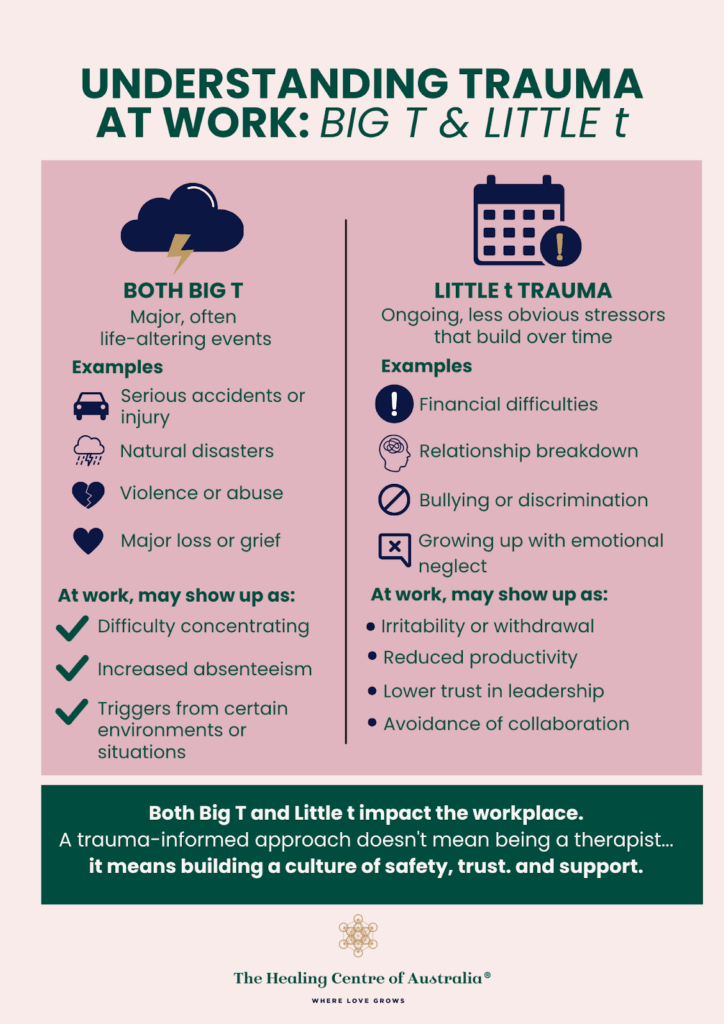
One of the most useful distinctions managers and HR can hold is between Big T and little t trauma:
Big T Trauma: Major events such as abuse, accidents, war, natural disasters—things widely considered “traumatic.”
Little t Trauma: Cumulative, repeated stressors, microaggressions, exclusion, unresolved conflict, chronic uncertainty.
While Big T can be more noticeable, “little t” events can erode wellbeing over time. People may bring both kinds of trauma into work. Recognising that trauma isn’t always a single dramatic event helps remove stigma and opens the space for more empathetic responses.
Embedding these is not a “checklist” exercise. It requires ongoing commitment, reflection, and iteration.
Supporting managers to lead well
One of the key insights from our round table was this: HR can’t just “know” trauma-informed practice, they must support managers to apply it. Here’s how:
1. Provide framing, language & scripts
Managers often hesitate because they don’t know what to say. Equip them with:
Opening phrases: “I’ve noticed some challenges lately, and I’m here to support you if you’d like to talk”
Listening prompts: “Would you like to share what feels difficult right now?”
Referral language: “You’re not alone, here are some support options (HR, EAP, etc.).”
Managers can’t, and shouldn’t, carry therapeutic burdens. Part of this training is defining boundaries:
Hold space (listen, validate, ask how you can support)
Refer onward (HR, EAP, external clinicians)
Know that asking someone if they’d like to talk is not therapy
As stated by Worksafe Queensland guidelines trauma-informed return-to-work processes: “This approach is not about being a therapist. It’s about taking a human approach… creating a safe space for recovery.”
3. Build psychological safety at team level
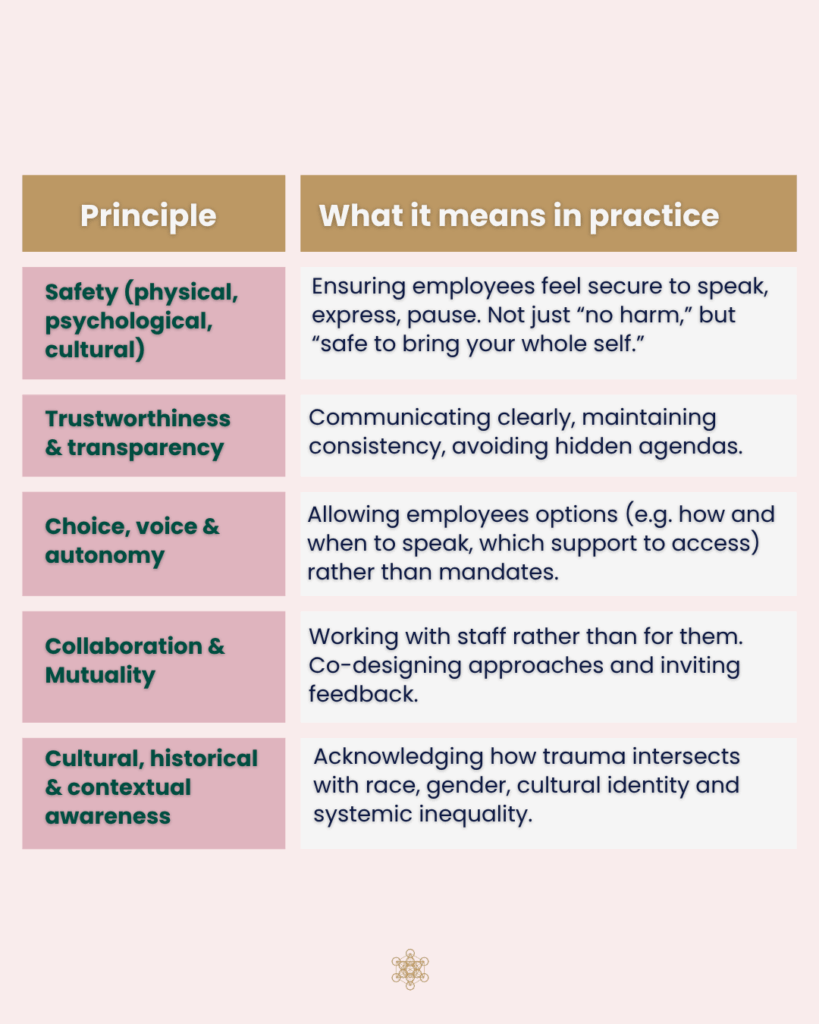
Managers can embed trauma-informed principles in their daily interactions:
Normalise pauses or check-ins
Encourage vulnerability (leader models: “I’m having a tough day too”)
Invite feedback on workload, process, support
Create space for team debrief or reflection
Psychological safety has been shown to be more predictive of high-performing teams than any other factor.
4. Use Trauma-Informed policies & HR processes
Managers should not act alone, HR must rewrite policy, process and structure through a trauma lens. This includes:
Grievance / harassment procedures designed to minimise retraumatisation (e.g. fewer repeated recountings, consent to retell, varied formats)
Performance or disciplinary frameworks that account for mental health context
Embedding trauma-informed language in documentation and role descriptions (avoiding language like “claim,” “complain,” or “accused”)
EAP support for all team members (making this known as much as possibel)
By doing this, managers have structural support rather than being the “sole buffer.”
Example of a Trauma-Informed Workplace (fictional)
A manager sees an employee, beginning to take more time off, withdrawing in meetings, and missing deadlines. Rather than waiting until things escalate, they initiated a one-on-one:
“Jessica, I’ve noticed some changes in your workload and presence, no judgments. I want to check in: how are you doing, and is there a way I can support you? If you prefer, we can talk about options or adjustments.”
Jessica didn’t share trauma immediately, but did say she’d been managing stress at home. The manager responded with validation (“That sounds incredibly heavy”) and offered possibilities, reduced deadlines for a fortnight, connecting to HR for options, and letting Jessica choose how she wanted to talk further.
That conversation built trust, prevented escalation, and allowed Jessica to feel seen, and it didn’t require the manager to act as a counsellor.
What HR should track
To ensure lasting impact, HR should monitor outcomes. Suggested metrics include:
Feedback on manager training (confidence, comfort in conversations)
Qualitative feedback: “Do you feel safe to share challenges?”
Trauma-informed organisational change is iterative. Use surveys and feedback loops to refine practices over time.
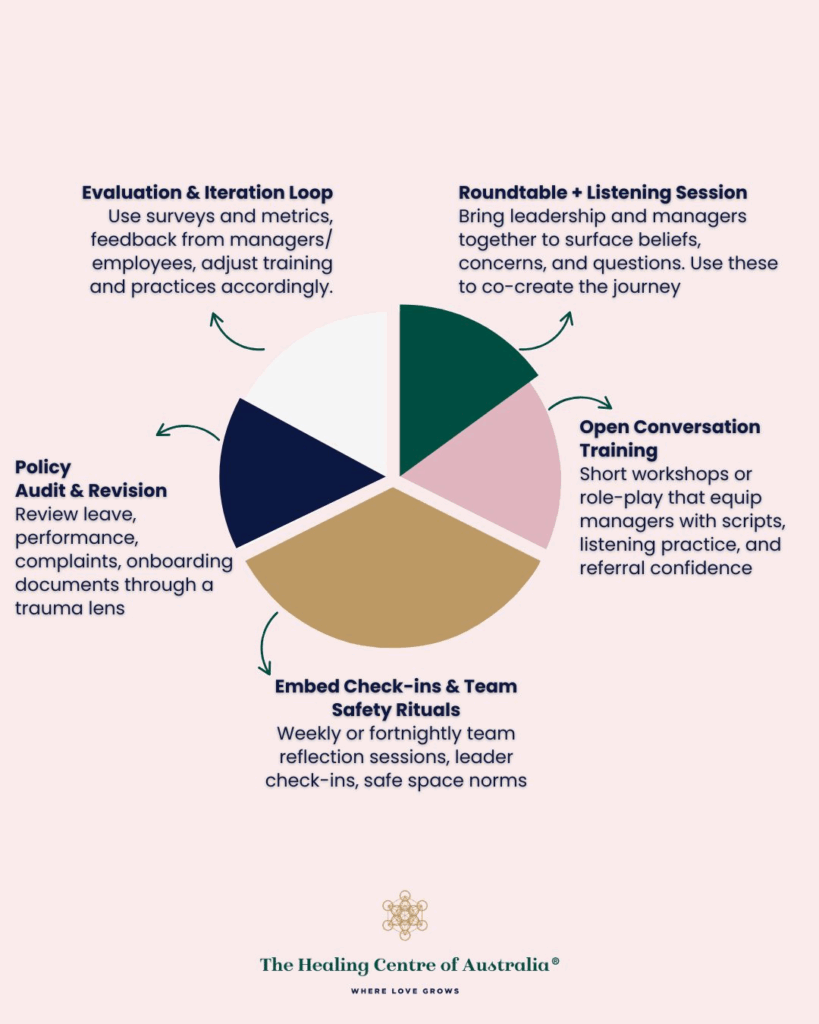
5 practical steps to help HR & Leadership be more wellbeing centric
1. Roundtable + Listening Session Bring leadership and managers together to surface beliefs, fears, and questions. Use these to co-create the journey.
2. Trauma-Informed Conversation Training Short workshops or role-play that equip managers with scripts, listening practice, and referral confidence.
3. Policy Audit & Revision Review leave, performance, complaints, onboarding documents through a trauma lens (safety, language, flexibility).
4. Embed Check-ins & Team Safety Rituals Weekly or fortnightly team reflection sessions, leader check-ins, safe space norms.
5. Evaluation & Iteration Loop Use surveys and metrics; feedback from managers/employees; adjust training and practices accordingly.
From awareness to practice – start now
HR does not need to wait for perfect conditions to begin. As the round table affirmed, nobody wants to get it wrong, but waiting often means harm goes unaddressed.
By shifting power, providing structure, and equipping managers with care (not clinical burden), organisations can move from well-intended rhetoric to trauma-informed practice.
If you’re ready to begin, you don’t need clinical expertise, just curiosity, humility, and a commitment. Over time, the small changes add up: healthier teams, more trust, and a workplace where everyone can bring their whole selves.
In workplaces across Australia, wellbeing is often addressed in short bursts. A special event here, a wellness morning there, an awareness campaign once or twice a year. While these moments are valuable reminders, they are not enough.
Health and wellbeing challenges don’t follow the calendar. Stress, burnout, chronic illness, and mental health issues affect employees every day, not just on marked occasions. If workplaces only act in recognition of “awareness moments,” they risk missing the bigger picture, and the cost is significant.
The business cost of ignoring wellbeing
Wellbeing isn’t “nice to have.” It’s a business must have. Research shows:
$6 billion – the yearly cost of poor psychological safety to Australian businesses due to lost productivity.
The recovery time for mental health compensation claims is four times longer than for physical injuries.
Up to 9.2% productivity loss – depression reduces workplace output, largely through absenteeism and turnover.
These statistics highlight how unaddressed wellbeing directly affects performance, retention, and organisational success.
When wellbeing is treated as an occasional campaign or awareness day, the results are surface-level. Posters come down, initiatives end, and employees return to “business as usual.”
To truly support employees, and protect long-term organisational health, workplaces must move beyond token gestures into proactive strategies.
Embedding wellbeing into workplace culture
Sustainable wellbeing means placing health into the culture of the workplace. It’s not about one-off programs, but ongoing commitment. Here’s what that looks like:
1. Make wellbeing part of everyday dialogue
Conversations about mental health, chronic illness, or menopause should not feel taboo. Leaders who normalise open, respectful dialogue make it safer for employees to speak up before challenges escalate.
2. Equip leaders with skills
Managers shape workplace culture more than any campaign. Training leaders in active listening, compassionate communication, and stress management equips them to respond effectively and build psychological safety.
3. Offer a diversity of tools
Every employee’s needs are different. Some may benefit from counselling or coaching, while others may respond better to mindfulness workshops, sound healing, or movement-based practices. Providing a variety of options ensures support is relevant and accessible. We have a range of ideas for you.
4. Prioritise prevention over cure
Too often, wellbeing programs are reactive, introduced only after issues have already escalated. By embedding preventative strategies, workplaces can reduce burnout, improve resilience, and catch small problems before they grow.
5. Align wellbeing with business goals
Wellbeing isn’t separate from business performance, it fuels it. Employees who feel supported are more engaged, more productive, and more likely to stay. Positioning wellbeing as a driver of organisational success helps leaders see its value clearly.
What if you don’t do it?
The absence of wellbeing strategies isn’t neutral, it actively undermines workplace culture. Employees facing unaddressed stress or health challenges are more likely to disengage, take extended leave, or exit altogether.
Low psychological safety can silence employees who might otherwise share valuable insights or concerns, reducing innovation and increasing risk. And for leaders, unmanaged stress can erode decision-making, communication, and the ability to guide teams effectively.
Over time, these challenges translate to lost productivity, higher turnover, reputational damage, and increased costs.
Building resilient workplaces
The organisations that thrive will be those that recognise wellbeing as foundational. This means:
Moving beyond short-term initiatives into ongoing, integrated programs.
Recognising wellbeing as both a human and commercial priority.
Equipping leaders to model and manage healthy behaviours.
Creating cultures where employees feel safe, supported, and empowered.
When wellbeing is embedded into everyday practice, the results extend far beyond reduced stress. Workplaces see improved morale, stronger connection, higher retention, and greater overall performance.
Wellness is a business strategy
By investing in proactive approaches, organisations can:
Reduce absenteeism and presenteeism.
Retain talent and reduce costly turnover.
Enhance resilience during periods of change.
Foster cultures of trust, safety, and engagement.
Ultimately, workplaces that prioritise wellbeing don’t just create healthier employees. They create stronger, more sustainable businesses.
Get started now
Awareness campaigns will always have their place, but true impact comes when what we acknowledge in those moments becomes part of everyday life at work.
The question for workplaces is not whether wellbeing matters. The question is: what are you doing to make it an everyday priority?
According to the Liptember Foundation’s 2025 report, 1 in 2 Australian women are currently living with a mental health condition. 1 in 4 are facing these challenges at a severe level.
Corporate wellness programs are initiatives designed to support employee health, wellbeing and productivity in the workplace. These programs go beyond standard benefits, offering resources and activities aimed at improving mental, physical and emotional health.
From stress management workshops to on-site activities (like mindfulness workshops), these programs focus on equipping employees with the tools they need to thrive. At The Healing Centre of Australia, we specialise in creating tailored programs that align with your organisation’s goals, offering services that range from mindfulness workshops to employee retreats.
By addressing workplace stressors holistically, these programs promote a healthier, more productive workforce.
How do Corporate Wellness Programs Work?
A customised corporate wellness program will integrate seamlessly into the organisation’s workplace culture, offering accessible, practical solutions for employees. Here’s how:
Needs Assessment and Customisation
The most effective programs begin with a thorough assessment of employee needs. Whether employees are experiencing high levels of stress, burnout or challenges with focus, programs are tailored to address these specific issues.
For example, if stress is a key concern, mindfulness and stress reduction workshops can provide employees with practical tools to better manage their workload and improve their focus. If your team needs a complete reset, our employee retreats offer an immersive, off-site experience to recharge and reconnect.
A Range of Offerings
Corporate wellness programs often include a variety of initiatives to support the full spectrum of employee wellbeing. At The Healing Centre of Australia, our services include:
Employee Retreats: These immersive retreats, held at our Australian-based retreat centres, provide your team with the opportunity to step away from their day-to-day environment, reset, and return to work with renewed energy and focus.
Mindfulness and Stress Reduction Workshops: One day workshops (available as a one-off, or quarterly for continued support) teach employees practical techniques to manage stress, improve concentration and enhance resilience.
Sound Healing Sessions: These group sessions use sound frequencies to release stress and create a calm, focused mind, providing employees with a deeply relaxing experience.
Reiki for Emotional Balance: A gentle, group-focused practice to help employees feel more centred, grounded and better equipped to handle workplace challenges.
Measurement and Feedback
For wellness programs to deliver lasting results and a worthwhile return-on-investment (ROI), it’s important to measure their effectiveness. Tracking employee engagement, stress levels and overall satisfaction ensures the program is meeting its goals and helps organisations to make adjustments for long-term success.
The Benefits of Corporate Employee Wellness Programs
Corporate wellness programs are not just an investment in employees—they’re a strategic approach to enhancing organisational performance. Here are some of the key outcomes:
Increased Productivity
When employees have access to tools like mindfulness workshops or group-focused activities like sound healing sessions, they’re better equipped to manage stress and maintain focus, resulting in higher productivity.
Reduced Absenteeism and Presenteeism
Burnout and stress-related absenteeism are major challenges for many organisations. Programs that use reiki for emotional balance for example, can help employees feel more grounded and capable, reducing absenteeism and improving presenteeism (when employees are at work but are unproductive).
Improved Employee Retention
Employees who feel valued and supported are more likely to stay with an organisation. Offering creative solutions like employee retreats shows a commitment to their long-term wellbeing, fostering loyalty and reducing staff turnover.
Better Workplace Morale and Team Dynamics
Group activities like sound healing sessions and stress reduction workshops can strengthen team relationships and boost morale. A team that feels connected and supported is more collaborative and motivated.
Long-Term Cost Savings
Addressing employee health proactively reduces healthcare costs and financial impact of absenteeism, white also preventing the high turnover costs associated with burnout and resignation.
Key Features of an Effective Corporate Wellness Program
The thing is, not all wellness programs are created equal. To achieve meaningful results, a successful corporate wellness program should include:
Accessibility: Programs should be easy for employees to participate in, whether through on-site workshops, digital platforms or off-site retreats.
Customisation: Tailored options, such as a combination of mindfulness training and reiki sessions, address the unique needs of your organisation.
Leadership Involvement: Leaders who participate in wellness activities help normalise these initiatives and reinforce their value to employees.
A Holistic Approach: Effective programs address mental, physical and emotional health. This might include everything from teaching mindfulness techniques to providing immersive experiences like sound healing.
Regular Evaluation: Continual feedback ensures the program is effective and adaptable to changing organisational and team needs.
Why Invest in Corporate Health Wellness Programs?
Investing in wellness programs isn’t just about employee satisfaction—it’s about creating an organisation that thrives. Here’s why corporate wellness programs are a smart business decision:
Attract and Retain Talent: A strong wellness culture makes your organisation a top choice for skilled professionals.
Build Resilience: Employees equipped with tools to manage stress—such as those learned in stress reduction workshops—are better prepared to handle workplace challenges.
Align with Business Goals: Healthy employees contribute to higher productivity, lower costs and a stronger bottom line.
Partner With The Healing Centre of Australia for Workplace Wellness
At The Healing Centre of Australia, we understand the importance of aligning wellness programs with organisational goals. Our corporate wellness programs combine evidence-based strategies with accessible, practical solutions to help your team thrive.
Our tailored offerings include:
Employee Retreats: A complete reset for your team at one of our amazing retreat centres, based around Australia.
Mindfulness and Stress Reduction Workshops: Practical tools for managing stress and improving focus, delivered as one-off or recurring sessions.
Sound Healing Sessions: Group-based relaxation through the power of sound frequencies.
Reiki for Emotional Balance: A gentle, restorative experience designed to help employees feel centred and grounded.
By choosing The Healing Centre of Australia, you’re investing in a program that goes beyond surface-level wellness to deliver meaningful, measurable outcomes.
Imagine a space where there’s no endless stream of notifications, no small talk and no pressure to tick off your to-do list. Instead, you’re surrounded by peace, stillness and the chance to reconnect with yourself.
This is what a silent retreat offers—a rare opportunity to hit pause and step back from the constant noise of everyday life.
Does the idea of silence feel a little intimidating? What will you do with all that quiet? What happens when there’s nothing and no-one to distract you?
But here’s the thing: that scariness, that fear, is *simply* a symptom of a frazzled nervous system that needs a reset. And this is what makes silent retreats so transformative.
5 Reasons to Experience a Silent a Retreat
If you’re curious about what a silent retreat might offer, here’s five benefits to inspire you to take the leap:
1. A Chance to Truly Disconnect
We live in a world of constant distractions, with our attention pulled in a hundred different directions at any given moment. A silent retreat gives you the chance to step away from technology, emails, social media—and the kids—creating space for your mind to slow down. Guests at our silent retreats describe feeling so much relief as they let go of their usual routines and allow themselves to simply be.
2. Time to Reconnect With Yourself
How often do you spend time truly listening to your own thoughts, without external noise getting in the way? Silent retreats create the perfect environment to reconnect with your inner self.
Through guided meditation, yoga and mindful practices, you’ll have the opportunity to reflect and gain clarity about what really matters to you. Whether you’re facing a big decision or simply looking for direction, the insights that come from this space can be profound.
3. A Deep Sense of Calm and Relaxation
Our silent retreats are designed to help you release tension and feel deeply rested. From sound healing sessions to a healing spa circuit, every element is thoughtfully crafted to soothe your nervous system and help your body reset. Imagine the stress melting away as you immerse yourself in calming practices and allow your body to experience true relaxation. Many guests leave feeling lighter, more focused and ready to re-enter the world with renewed energy.
4. Connection Without Conversation
While silent retreats are about personal reflection, they also provide a unique opportunity to connect with others on a deeper level. Without words, you’ll find a quiet camaraderie with like-minded individuals who are also seeking space and clarity. There’s a special kind of magic in sharing a silent experience with others—each person is on their own journey, yet there’s a sense of mutual support and connection that develops naturally—without the energy and effort needed for face-to-face conversations.
5. Tools You Can Take Back to Daily Life
The benefits of a silent retreat don’t end when you leave. You’ll return home with practical tools and techniques to help you manage stress, find focus and bring more mindfulness into your everyday life. From mindfulness practices and journaling habits, to the sense of calm you’ve cultivated from the inside out, our silent retreats are designed to create lasting change.
What Makes Our Silent Retreats Unique
At The Healing Centre of Australia, we’ve created silent retreats that combine peace, purpose and flexibility. Each retreat is held at a beautiful location with natural surroundings and carefully curated experiences, such as:
Yoga and Meditation: Guided sessions for every mind and every body.
Sound Healing: Relax and reset with the therapeutic power of sound frequencies.
Reiki Healing: Enjoy one-on-one sessions for an extra boost of balance and emotional wellbeing
Healing Spa Circuit: Make your way through our sauna, steam room, spa and magnesium pool.
Mindful Meals and Accommodation: Nourishing, delicious meals and beautiful rooms designed to support your experience.
Is a Silent Retreat Right for You?
If you’ve been feeling overwhelmed, disconnected, “full up”, or simply in need of a reset, a silent retreat could be exactly what you need.
You don’t need any previous experience—just bring an open mind and a willingness to explore what’s possible when you give yourself space to pause and reflect.
Ready to Discover the Power of Silence?
Curiosity is often the first step on the journey to transformation. It’s that little whisper that grabs your attention and wants to know more.
So, if you’re wondering what it would feel like to spend a few days in stillness, reconnecting with yourself in some much needed peace and quiet, then we’d love you to join us.
Our silent retreats are carefully designed to support you every step of the way, offering a safe, nurturing environment to explore mindfulness, relaxation and personal growth.
There’s no single roadmap that we should all follow to feel happy and healthy. What works for one person might not work for another—and that’s ok. Everyone’s journey to feeling balanced, calm and centred is unique.
For many people, exploring healing practices can feel like stepping into unknown territory. You might wonder, “what if it doesn’t work for me?” or “what if it feels strange?” or “what will other people think?”. But here’s the beauty of this journey: It’s all about finding opportunities to discover what feels good for you. And that’s something only you can know.
Your path to wellness is guided by your curiosity—that little voice that says, “hey, this could be interesting”. It’s about letting this curiosity guide you, even when that voice of self doubt that says “no, I can’t do that” tries to get in the way.
No One-Size-Fits-All Approach to Wellbeing
Healing isn’t about finding the “right” practice—it’s about finding what feels right for you. This could be a single practice or a combination of different modalities that resonate with your mind, body and spirit.
The key to this process is experimentation. Maybe you start with something you’ve heard of before, like meditation or yoga. Or perhaps you feel drawn to something new, like sound healing or reiki. There’s no right or wrong answer—it’s about exploring, trying and noticing how these practices make you feel afterwards.
Healing is a journey, not a destination. What supports you today might not be the same thing that supports you a year from now—and that’s totally ok!
Healing Practices to Explore
If you’re curious about where to start, here are a few healing practices you might consider exploring. Each one offers a different way to support your wellbeing:
Meditation and Mindfulness
Meditation is a simple, yet powerful, practice for calming the mind and finding balance. Whether it’s focusing on your breath, trying guided meditations, or simply sitting in silence watching the clouds go by, mindfulness can help you to come back to “now” and slow down your busy mind.
Sound Healing
Using sound to heal is an ancient practice and it’s becoming increasingly popular for its calming and restorative effects. During a sound healing session at The Healing Centre of Australia, you’ll experience a delicious combination of meditation, breathwork and the magical sound of crystal bowls alongside nine other carefully selected instruments. Whether it’s the gentle ding of a crystal bowl or the deep dong of a gong, all you need to do is lie down, listen and feel the soothing effects of the sound moving through you.
Reiki is a gentle, non-invasive practice that promotes emotional and physical healing through energy work. You might feel warmth, tingling or simply a sense of calm during a reiki session. It’s a simple way to help your body and mind feel more aligned and centred.
If you’re someone who needs to move to feel good, you might be drawn to practices like yoga, pilates or tai chi. These mindful movements not only support your physical health, but also help to calm the mind and improve your focus.
Silent Retreats
If the thought of stepping away from the noise of daily life really appeals to you, then a silent retreat might be the perfect opportunity to reset. These retreats provide a quiet, supportive space to explore mindfulness, reflect and recharge.
Healing is a deeply personal journey and the best guide you have is your own curiosity. If a particular practice or modality catches your eye, even if you’ve never tried anything like it before, consider giving it a go.
It’s natural to feel unsure or even skeptical at first. But you might find that by stepping out of your comfort zone, you discover something that truly supports you. Remember, there’s no need to have it all figured out right away—wellbeing is an ongoing journey of curiosity, exploration and practice.
Take the First Step on Your Healing Journey
If you’re feeling curious about exploring different healing practices, now is the perfect time to start. At The Healing Centre of Australia, we offer a range of evidence-based and holistic options for you to choose from.
Whether you’re curious about sound healing, reiki, mindfulness workshops, or even a silent retreat, our sessions are created with your wellbeing in mind. You don’t need to know where to start—just take that first step (and even bring along a friend!) and we’ll be here to guide you.
Wellness Isn’t About One Solution—It’s About Having the Right Tools
When something breaks in your home, you reach for the right tool to fix it. You wouldn’t use a hammer when you need a screwdriver and you wouldn’t try to repair everything with the same tool.
Your health and wellbeing work in the same way. No single solution can fix everything and different challenges require different approaches. Some tools, like mainstream medicine, provide a strong foundation, while others, like mindfulness or reiki, can help you manage stress, support emotional balance or improve your overall wellbeing.
Instead of searching for one “perfect” way to feel better, what if you created a holistic wellness toolbox instead? This way, you’ll have a collection of practices and supports that work together to help you feel your best.
Why You Need More Than One Tool for Wellbeing
Many people view wellness in black and white terms:
“I only trust medical professionals.”
“I only use natural remedies and practices.”
“If I see a psychologist, I shouldn’t need mindfulness or meditation.”
“If I take medication, I don’t need anything else to feel better.”
But wellness isn’t either/or, it’s both/and. Science and holistic wellness practices can work together to create a more complete and balanced approach to health.
For example:
A person managing chronic pain might feel relief from both physiotherapy and reiki.
Someone struggling with stress and anxiety might benefit from both talking therapy and mindfulness practices.
A person dealing with insomnia might follow medical advice while also using sound healing or breathwork to relax before bed.
Can you see that by combining different tools, you can give yourself more options and more support—rather than relying on just one method and hoping it works for everything?
How to Build Your Own Wellness Toolbox
Since everyone’s needs are different, your wellness toolbox should be personal to you. Here’s how to start building yours:
Step 1: Identify Your Needs
Ask yourself:
What are the biggest challenges I face in my health and wellbeing?
When do I feel most stressed, overwhelmed or out of balance?
What areas of my wellbeing could use more attention?
Once you can identify where you need support—whether it’s mental clarity, emotional balance, physical health or stress management—you can start exploring tools that work for each specific need.
Step 2: Explore Different Tools
Think of this as trial and error—you don’t need to find all of the answers right away. The key is to stay open and curious, allowing yourself to try different practices and see what resonates with you.
Here are some tools that you could put in your holistic wellness toolbox:
Medical and Professional Support: GP visits, psychology, physiotherapy or medications when needed.
Mindfulness and Meditation: Guided meditation, breathwork or silent retreats.
Energy-Based Practices: Reiki, acupuncture or sound healing.
Movement and Physical Health: Yoga, exercise, massage therapy.
Nervous System Regulation: Cold water therapy, deep breathing, restorative yoga.
Some tools will work better for you than others. So, you don’t need to love everything you try—just use what helps and leave what doesn’t.
Step 3: Know When to Use Each Tool
Even when you find what does work for you, not every tool is meant for daily use. Some are foundational (like regular exercise or meditation), while others might be used as needed (like seeing a mental health professional during a stressful period).
For example:
You might use breathwork daily to reduce stress, but book a reiki session once a month for deeper emotional balance.
You may follow medical treatments consistently while using sound healing as a relaxation tool when needed.
A silent retreat might be something you do once a year, while mindfulness becomes a weekly practice.
The goal is to have different options available so you can choose the right tool at the right time.
Your Toolbox Will Evolve Over Time
Your needs, challenges and interests will change over time—and that means your wellness toolbox should grow and evolve with you.
What helped you last year might not be the same thing that helps you today.
You may discover new practices that support you better than old ones.
Some tools will be temporary, while others will be lifelong.
And that’s okay! Wellness isn’t about following a rigid formula—it’s about flexibility, learning and growth.
Let’s Help You Find the Right Tools
At The Healing Centre of Australia, we believe in a balanced approach to health and wellbeing. Whether you’re looking for stress management tools, emotional support, or deep relaxation, we offer a range of holistic practices that can complement and support your existing wellness routine.
Curious about whether reiki sessions,sound healing, asilent retreat or a mindfulness workshop could be part of your holistic wellness toolbox?