

Sustainable school wellbeing starts with staff capacity
Regulated staff create calm schools. When teachers and leaders have the capacity to stay steady under pressure, they can support students more effectively, every day.


Organisations we’ve worked with:






When leadership and classrooms are both under strain
Schools are carrying more than ever. Staff are stretched by workload, administration, and emotional demand, while student mental health needs continue to escalate in complexity and intensity. Despite good intent, one-off PD days and external programmes haven’t created lasting change, leaving teachers and leaders feeling out of their depth when pressure is high.
The gap isn’t awareness or care. Staff and leadership teams usually know what good practice looks like, but pressure from parents, behaviour challenges, and critical incidents can overwhelm even experienced educators.
When leadership teams don’t have the capacity or training to stabilise pressure across the school, teachers carry it in classrooms and behaviour escalations increase.
You can’t build calm, stable school environments if the people guiding them don’t have the tools to regulate themselves first.
Who this is for and who it isn’t
This is for schools where:
- Leadership teams want stronger tools to support staff, parents, and complex school pressures
- Staff exhaustion is affecting teaching quality, relationships, and retention
- Teachers and leaders feel underprepared for escalating behaviour and student mental health needs
- Wellbeing feels reactive, inconsistent, or dependent on a small number of people holding everything together
This is not for schools that:
- Want a one-off PD session with no follow-through
- Only want student programmes without supporting staff first
- Expect quick fixes without embedding daily practice
- Are looking for a generic, plug-and-play programme
This clarity protects everyone’s time. Our work is built as a partnership for schools ready to invest in sustainable, whole-school change rather than short-term fixes.

Three areas, one whole-school system
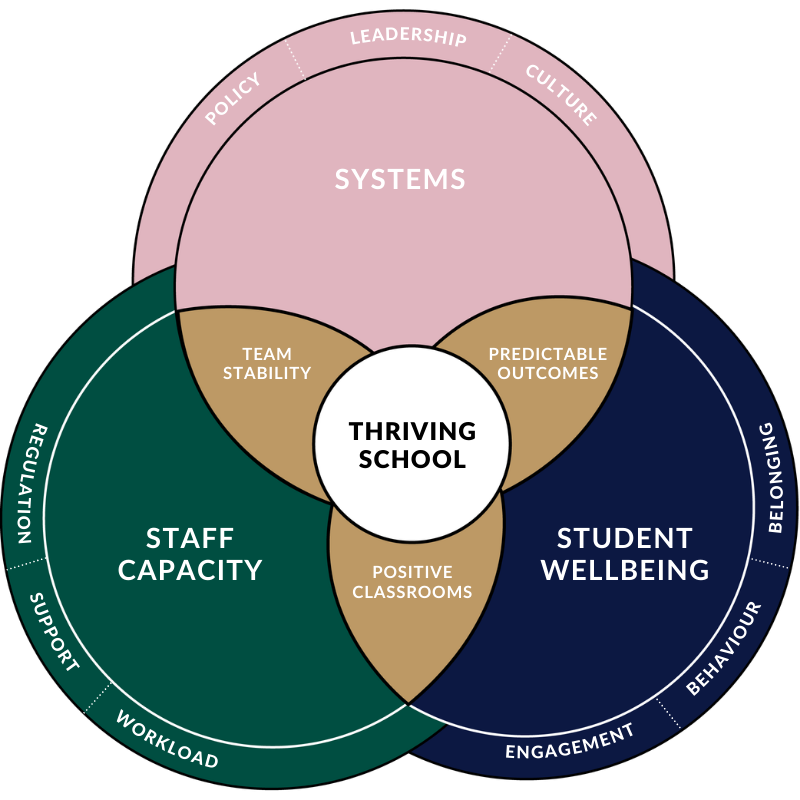
Most wellbeing offerings focus on one layer, student programmes, a standalone PD day, or policy and frameworks.
We align three areas as one system, so the work is practical, embedded, and sustainable.
We start with a short assessment to understand what your school actually needs, then recommend the right combination, without adding “one more programme” to an overloaded staffroom.
These areas work together as one system. Systems provide structure. Staff capacity determines whether that structure holds under pressure. Student wellbeing improves when adults can model and sustain what they’re teaching.
Fixing only one doesn’t work:
- Systems without staff capacity become paperwork under pressure
- Staff capacity without systems becomes personal effort with no scaffolding
- Student programmes without staff capacity become another thing staff can’t maintain
That’s why we build staff capacity first, then embed what follows.
Where we start:
The School Wellbeing Snapshot
Our assessment looks at how leadership, school systems, staff capacity, and student wellbeing are working together in real conditions.
It shows where gaps exist and what your school actually needs, so decisions are based on evidence.
What it includes:
- Review of existing wellbeing frameworks, systems, and duty of care pathways
- Staff and leadership pressure points, wellbeing load, and capacity patterns across roles
- Student behaviour and wellbeing patterns that are driving time and escalation
- A clear gap map showing what to strengthen first
Why schools choose this:
- Prevents wasted time and budget on solutions that don’t stick
- Provides an evidence-based starting point for action
- Aligns with duty of care and wellbeing framework requirements
- Focuses on systems and capacity, not blaming individuals
- Supports budget-conscious decision-making by prioritising what matters most
Based on the findings, we recommend the most appropriate next steps for your school. That may involve targeted support in one or two areas, a staged approach that builds staff capacity before moving into classrooms and student support, or a more comprehensive whole-school transformation where needed.
Starting with assessment ensures effort and budget are invested where they will have the greatest impact, rather than adding another layer of activity without lasting change.
Capacity building in the right order: Staff, classrooms, then students


Most school wellbeing initiatives start with students. The problem is, if staff don’t have the awareness, education, and capacity to manage pressure themselves, those programs struggle to embed or create lasting change.
We take a different approach, building leadership and staff capacity first, then applying it in classrooms and leadership, and only introducing student programs once the foundations are in place.
→ Phase 1: Staff regulation
We begin by supporting all school staff to build practical regulation skills they can use in real time. This includes classroom teachers, school leaders (principals and deputies), wellbeing coordinators, and support staff who interact with students every day.
- Staff learn simple, evidence-based techniques to manage pressure as it happens, including breathwork, emotional regulation skills, and strategies for staying present and steady during challenging moments.
- For leaders, this supports calmer decision-making, parent interactions, and crisis management.
- For teachers, it supports classroom calm, behaviour management, and emotional containment.
This phase comes first because calm schools start with regulated adults, at every level.
→ Phase 2: Classroom and leadership application
Once staff have the capacity to regulate themselves, those skills are applied directly to daily practice.
- Teachers learn how to translate regulation into calmer classroom environments, more effective behaviour support, and consistent modelling for students.
- School leaders apply the same principles to leadership under pressure, managing difficult conversations, and shaping a whole-school culture that feels steady rather than reactive.
This phase works because staff are no longer trying to apply strategies while running on empty. Capacity comes first, then skills, then sustainable change.
→ Phase 3: Student wellbeing support
Once staff have the capacity to regulate themselves, those skills are applied directly to daily practice.
- Teachers learn how to translate regulation into calmer classroom environments, more effective behaviour support, and consistent modelling for students.
- School leaders apply the same principles to leadership under pressure, managing difficult conversations, and shaping a whole-school culture that feels steady rather than reactive.
Student wellbeing programmes don’t hold when staff are exhausted. Staff need the capacity to regulate themselves before they can teach, lead, or support students consistently.
Leaders also need regulation capacity to maintain a steady whole-school culture under pressure. This sequencing is evidence-based, practical, and built to last.
The 4-Stage Process:
How lasting change is built
This framework is used when the assessment shows deeper, system-wide support is needed. It outlines how staff build sustainable capacity over time, rather than relying on one-off training.
Not every school needs all four stages. The assessment determines what’s required and at what depth.
Reset
Staff build the capacity to stay steady under pressure using practical regulation tools. This creates the foundation for learning and behaviour change to hold. Reset is not a one-off, it continues throughout the process.
Relearn
With capacity in place, staff develop a shared understanding of pressure, triggers, and behavioural patterns through trauma-informed education. This helps teams recognise what’s happening and why.
Delivered by Ashton.
Rebuild
New approaches are embedded into daily practice. Teachers apply regulation to classroom management, while leaders focus on steady decision-making and leadership under pressure. Training is role-specific so change is practical, not theoretical.
Delivered by Lou, with leadership support from Thilan or Ashton as required.
Reinforce
Ongoing support, resources, and check-ins prevent regression and help new practices stick. This stage maintains gains and supports a sustainable whole-school culture.
This is a flexible, assessment-led framework. Some schools only require targeted support in one or two stages. The approach is tailored to your context, priorities, budget, and capacity.
What change can look like when schools work with The Healing Centre of Australia

Building staff capacity to manage pressure, alongside strengthening leadership capability, shifts a school culture from reactive crisis response to steadier, more confident practice.
Here is what that looks like across the school:
→ Early signals (6-12 weeks):
- Staff reporting lower overwhelm and more confidence in high-pressure moments
- Fewer classroom escalations and smoother behaviour responses
- Leadership decisions feeling steadier during incidents, parent contact, and critical moments
→ Supporting signals:
- Improved staff check-in feedback and morale
- Fewer repeat behaviour issues across the same classes or year levels
- More constructive parent-school interactions during challenging situations
→ Over time (6-12+ months):
- Reduced absenteeism and improved retention
- Fewer critical incidents and smoother escalation pathways
- Stronger staff and student wellbeing measures and culture indicators
We track early signals first, then longer-term outcomes, so progress is visible before end-of-year data catches up.
How we work with your school
Step 1: Discovery call
This conversation helps clarify whether an assessment is the right next step. No solutions are presented at this stage.
Step 2: Assessment and recommendation
Following the discovery conversation, we return with a clear, tailored plan outlining recommended next steps aligned with your school’s specific context, staff needs, and wellbeing priorities.
During this conversation, we:
- Outline the recommended approach for your school
- Explain why these steps are the right fit for your staff, leadership team, and students
- Discuss priorities, scope, and practical sequencing across the school
Step 3: Implementation and follow-through
Implementation is guided by the tailored recommendations outlined in your proposal. Because every school is different, delivery is shaped around your staff, leadership team, school culture, and operational realities.
We partner with leadership teams and staff to implement the agreed plan, establish clear indicators of progress, and embed sustainable wellbeing practices that support both staff and students.
This is a partnership, not a packaged program. We adapt to your school’s needs, budget, and capacity, focusing on what will make the most practical and sustainable difference.

Evidence-based, practical, and built for schools
- 31,200+ clinical hours informing evidence-based approaches to regulation, behaviour, and wellbeing
- Delivered in education settings, supporting staff and leadership teams in complex, high-pressure school environments
- Led by specialists in staff regulation and wellbeing, with deep experience supporting teachers and school leaders under sustained pressure
- Whole-school, trauma-informed approach aligned with the Australian Student Wellbeing Framework and duty of care obligations
We build staff capacity and regulation to support wellbeing, behaviour, and duty of care in schools. This work is preventative and educational in nature. We do not deliver therapy, diagnosis, or clinical treatment.
Common questions schools ask
We don’t have the budget for another program, how is this different?
We understand schools are already stretched. That is why our approach focuses on supporting the areas that will make the biggest difference for your staff, leadership team, and students, rather than adding another generic initiative. Schools often see long-term cost savings through improved staff retention, reduced absenteeism, and fewer critical incidents.
Our staff don’t have time for more training, won’t this add to workload?
This isn’t additional training layered onto busy schedules. Regulation skills are embedded into daily practice and leadership decision-making, reducing time spent managing behaviour, conflict, and escalation. The aim is to ease pressure, not add to it.
We’ve tried PD days before and nothing stuck, why would this be different?
One-off PD focuses on awareness, not capacity under pressure. This work includes follow-through and reinforcement, so skills are used in real situations. The assessment-led model ensures the right depth of support, rather than repeating what hasn’t worked before.
How quickly should we expect to see results?
Early indicators often appear within weeks, calmer staff responses, improved classroom tone, and greater confidence under pressure. Cultural change takes longer, but progress is tracked early so impact is visible well before long-term data or surveys catch up.

If your staff are exhausted and student needs are escalating
If you’re tired of reactive wellbeing efforts and want an embedded approach that supports teachers and leaders first, the next step is a short discovery call to understand your context and determine whether an assessment is the right place to begin.
If your staff are exhausted and student needs are escalating
If you’re tired of reactive wellbeing efforts and want an embedded approach that supports teachers and leaders first, the next step is a short discovery call to understand your context and determine whether an assessment is the right place to begin.
Insights for supporting staff, leadership, and student wellbeing
Practical, evidence-informed perspectives on staff capacity, school wellbeing, behaviour support, and sustainable whole-school change

Your 2026 workplace wellbeing audit: A checklist and action plan for change
Your 2026 workplace wellbeing audit: A checklist and action plan for changeAs organisations gear up for the year ahead, one thing is clear: performance and wellbeing can no longer be separate conversations. At The Healing Centre of Australia, we’re seeing a shift....

Doing 2026 differently: the new priorities for organisational wellbeing
Doing 2026 differently: the new priorities for organisational wellbeingRight now, many leaders are feeling it: fatigue, disconnection, and pressure to do more with less. We are seeing it in the conversations we are having. But here’s the opportunity: 2026 can be...

Psychological health at work: don’t ignore all the warning signs
Psychological health at work: don’t ignore all the warning signsAs of 1 December, new psychological health compliance codes are now enforceable in Victoria - a move that rightly places greater responsibility on employers to address psychosocial hazards in the...