
Your 2026 workplace wellbeing audit: A checklist and action plan for change

As organisations gear up for the year ahead, one thing is clear: performance and wellbeing can no longer be separate conversations.
At The Healing Centre of Australia, we’re seeing a shift. More leaders are asking: “How do we stop talking about wellness and actually embed it?” And that’s exactly what this audit is designed to support.
This is your invitation (as a leader or within People and Culture/HR) to pause, assess, and realign your approach to workplace wellbeing, and to take practical action now, not later. Because the truth is, the way you care for your people shapes the way they show up. And the way they show up impacts everything.
Whether you’re leading a team, managing operations, or setting strategy, this blog will guide you through a full wellbeing audit for your organisation, and offer specific, realistic actions to take in 2026.
Why audit your workplace wellbeing in 2026?
Performance depends on people and people can’t perform if they’re in survival mode.
Burnout, disengagement, and overwhelm aren’t personal failings; they’re often signs that the system isn’t working. This audit is your opportunity to rewire that system.
As we explored in our related article, “Doing 2026 differently: the new priorities for organisational wellbeing”, real change starts with the nervous system. When stress builds, our ability to think, connect, and contribute goes down. But when teams feel safe, grounded, and supported, they perform.
Let’s build on that insight with a deeper look at what 2026-ready workplaces really need.
PART 1: The 2026 Workplace Wellbeing Audit
Leadership and Culture
- Do your leaders know how to recognise stress and dysregulation?
- Is psychological safety embedded in how meetings, feedback, and decisions are handled?
- Are there consistent rituals or rhythms that support team connection and check-ins?
If not…
Run a short leadership training on nervous system regulation and trauma-informed language. Begin meetings with a check-in question: “Where’s your energy at today?”
Recovery and Regulation
- Do you have recovery practices built into the way you work (not just as a “perk”)?
- Are there regular moments of pause, breath or rest in your workplace rhythm?
- Do people feel they can take a break without guilt or pressure?
If not…
Introduce a 5-minute “decompression break” after team meetings. Offer guided breathwork or mindfulness resources (even pre-recorded!). Trial a monthly team sound healing or silent working session.
Policies and Process
- Do your performance, feedback, and grievance systems reflect trauma-informed principles?
- Is there flexibility in how work gets done (especially during high-pressure periods)?
- Do your policies include provisions for psychosocial safety?
If not…
Review one key policy (e.g. return to work, complaints, or performance) with a trauma-informed lens. Ask: Does this create choice, voice, and safety?
Space and Environment
- Is your workplace designed with nervous system regulation in mind?
- Are there quiet zones, natural light, or areas for decompression
- Can remote and in-person staff equally access wellbeing resources?
If not…
Reclaim a meeting room as a “calm room.” Use simple design (soft lighting, cushions, plants). Give remote staff access to virtual wellbeing sessions or mindfulness breaks.
Purpose and Participation
- Are your people involved in shaping wellness strategies — or are they just receiving them?
- Do your teams feel heard, seen and valued?
- Are wellbeing initiatives aligned with your actual business goals
If not…
Run a team co-design session. Ask: “What’s helping your wellbeing right now? What’s getting in the way? What would make the biggest difference next year?”
PART 2: The Action Plan
Here’s how to move forward with integrity, not overwhelm:
1. Map your capacity cycle
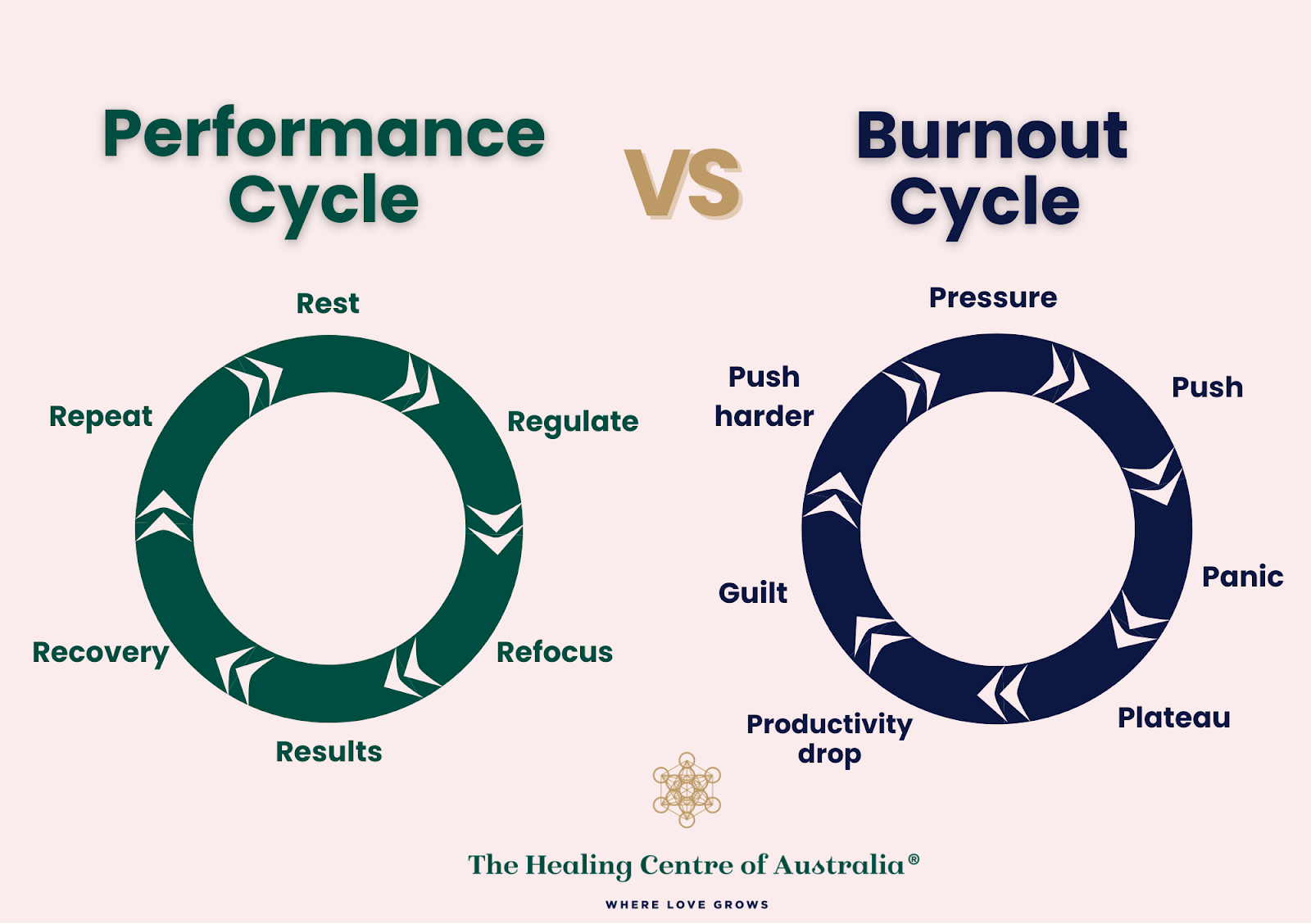
Performance Cycle: Rest → Regulate → Refocus → Results → Recovery → Repeat
Burnout Cycle: Pressure → Push → Panic → Plateau → Productivity drop → Guilt → Push harder
Ask: Where are our teams currently operating? What systems encourage recovery vs push-through?
2. Create a 3-month wellness integration plan
Instead of launching big new programs, choose 3 micro-changes to implement each month. For example:
- January: Leadership check-in ritual + wellbeing audit
- February: Team breathwork + policy review
- March: Calm zone + co-design session
3. Set your “health of the org” metrics
Don’t just track outputs. Track:
- Team energy & capacity scores (pulse surveys)
- Psychological safety levels
- Utilisation of support programs
- Feedback from wellbeing initiatives
4. Keep listening
Make feedback loops part of your strategy. Ask your people what’s working and what’s not, regularly. The more we listen, the better we can lead.
The bottom line: when you look after the team, they look after the business
This audit is just as much a performance tool as it is a wellbeing tool just a wellbeing tool. Because when people feel safe, they show up with more clarity, creativity and capacity.
2026 doesn’t need to be harder. It just needs to be different.
Let’s build a workplace where regulation isn’t a trend, it’s a foundation.
Want help conducting your 2026 audit? Get in touch with us to co-design your wellbeing roadmap.
Check out our previous article for further insights: “Doing 2026 differently: the new priorities for organisational wellbeing”
Ready to make 2026 the year of integration, not just intention? Learn more here.
Explore our recent insights
Short, evidence-led thinking on psychosocial risk, leadership behaviour, and capacity

Doing 2026 differently: the new priorities for organisational wellbeing
Doing 2026 differently: the new priorities for organisational wellbeingRight now, many leaders are feeling it: fatigue, disconnection, and pressure to do more with less. We are seeing it in the conversations we are having. But here’s the opportunity: 2026 can be...

Psychological health at work: don’t ignore all the warning signs
Psychological health at work: don’t ignore all the warning signsAs of 1 December, new psychological health compliance codes are now enforceable in Victoria - a move that rightly places greater responsibility on employers to address psychosocial hazards in the...

What a Trauma-Informed Workplace looks like (a guide for HR & managers)
What a Trauma-Informed Workplace looks like (A guide for HR & managers)At a recent round table with HR leaders, one theme kept surfacing: we all know “trauma-informed workplaces” are important, but many fear they could get it wrong. Managers worry about...